M-Pesa Integration for Business in Kenya: Everything You Need to Know
Learn how M-Pesa integration works, why Kenyan businesses are automating payments, and how it improves efficiency, customer experience, and business growth.
Why M-Pesa Integration Is Becoming Essential for Businesses in Kenya
Over the last decade, Kenya has become one of the world’s leading examples of digital payment adoption, largely driven by the widespread success of M-Pesa.
What began as a simple mobile money transfer service has evolved into essential financial infrastructure that powers millions of transactions every day. From buying groceries and paying school fees to settling rent and purchasing products online, M-Pesa has transformed how consumers and businesses exchange money.
For businesses, this shift has created both new opportunities and new expectations. Customers increasingly prefer fast, secure, and convenient payment methods, and many now expect businesses to offer M-Pesa as a standard payment option.
At the same time, businesses face growing pressure to improve operational efficiency, reduce payment delays, and create better customer experiences.
Despite this reality, many companies in Kenya still handle M-Pesa payments manually. Customers make payments, send screenshots or transaction codes through WhatsApp, and staff manually verify transactions before products or services are delivered.
While this method may work for very small businesses, it becomes increasingly inefficient as transaction volume grows.
This is where M-Pesa integration becomes important. Businesses are moving beyond simply accepting M-Pesa payments and are now integrating M-Pesa directly into their systems, websites, and applications to automate payment processing.
But what exactly does M-Pesa integration mean, and why are so many businesses investing in it?
Understanding M-Pesa Integration
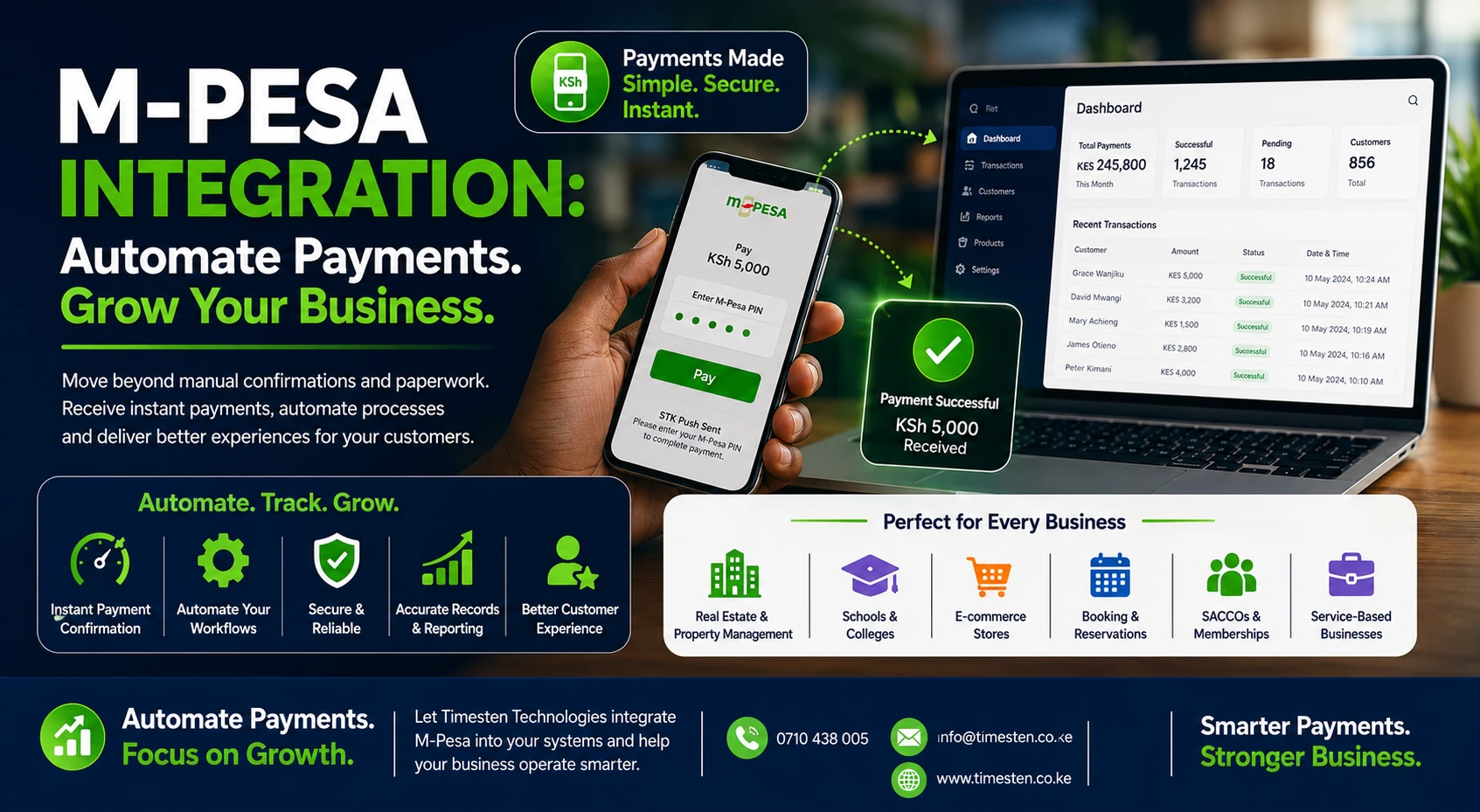
M-Pesa integration refers to connecting a business system, website, or application directly with Safaricom’s M-Pesa payment services in a way that automates transactions and payment confirmations.
Instead of relying on manual verification, integrated systems communicate automatically with M-Pesa and receive instant updates whenever a customer successfully completes a payment.
In practical terms, this means that when a customer pays for a service or product, the system automatically detects the payment, verifies the amount, updates records, and triggers the next action without requiring staff intervention.
For example, imagine a customer booking accommodation online or paying rent through a property management platform. Rather than sending proof of payment and waiting for confirmation from an administrator, an integrated system can instantly recognize the payment, issue a receipt, update the customer’s account, and notify relevant parties in real time.
The same concept applies to online stores, schools, booking systems, SACCOs, subscription-based businesses, and many other sectors.
M-Pesa integration reduces delays, improves transparency, and significantly minimizes the manual work involved in managing payments.
Why Manual Payment Handling Is Becoming a Problem for Businesses
Many Kenyan businesses still depend heavily on manual processes for payment confirmation.
Typically, customers are instructed to send money to a paybill or till number and then forward a screenshot or transaction message through WhatsApp or SMS for confirmation. Someone in the office then checks the message, confirms payment, and manually records it.
At first glance, this may appear manageable. However, as businesses grow, hidden inefficiencies quickly become apparent.
One of the biggest challenges is time consumption. Staff often spend a significant portion of their day verifying payments, responding to payment inquiries, reconciling transactions, and resolving disputes.
This time could instead be spent serving customers, improving operations, or focusing on business growth.
Human error also becomes a major concern. Payments can easily be missed, assigned to the wrong customer, or incorrectly recorded.
A customer may pay the correct amount but experience delays simply because someone forgot to verify the transaction.
Customer experience is another major factor. Today’s consumers are accustomed to instant digital experiences and expect quick confirmation and fast service delivery.
Delays caused by manual verification often create frustration and negatively affect trust in a business.
As customer expectations continue evolving, businesses that fail to modernize payment systems risk appearing outdated and inefficient.
How M-Pesa Integration Works in Real Business Environments
Although M-Pesa integration may sound highly technical, the customer experience is usually simple and seamless.
Consider an online business selling products. Once a customer selects products and proceeds to checkout, they simply enter their mobile phone number.
The system automatically triggers what is commonly known as an STK Push, sending a payment request directly to the customer’s phone.
The customer enters their M-Pesa PIN to authorize payment, and within seconds, the system receives confirmation directly from Safaricom.
From there, automation takes over.
Depending on system configuration, payment can automatically trigger several actions. An online store may generate an invoice and begin order processing immediately. A property management system may instantly update a tenant’s rent balance. A school management platform may automatically update fee records. A booking platform may confirm reservations without staff involvement.
The beauty of integration lies in removing repetitive manual work while reducing errors and improving speed.
Industries Benefiting Most from M-Pesa Integration in Kenya
While nearly every business can benefit from payment automation, some sectors experience especially significant advantages.
Real Estate and Property Management
Landlords and property managers increasingly use M-Pesa integration to simplify rent collection.
Instead of manually following up with tenants and verifying payment messages, integrated systems automatically track payments, generate receipts, and maintain accurate financial records.
Educational Institutions
Schools are rapidly adopting integrated payment systems to automate school fee tracking and maintain organized financial records more efficiently.
E-Commerce Businesses
Online shoppers expect instant payment confirmation and fast order processing.
Businesses that automate payments reduce checkout friction and improve conversion rates.
Service-Based Businesses
Cleaning companies, event organizers, travel agencies, consultants, car hire businesses, and similar service providers benefit from simplified booking deposits and service payments.
Subscription and Membership Businesses
Subscription-based businesses and organizations increasingly integrate M-Pesa to simplify recurring payments and reduce payment defaults.
The Business Benefits of M-Pesa Integration
The growing adoption of M-Pesa integration is not simply about convenience — it is about improving overall business performance.
Faster Payments
Automated payment confirmation drastically reduces delays, enabling faster service delivery.
Improved Accuracy
Since transactions are recorded automatically, businesses reduce the risk of missed payments, duplicate entries, and reconciliation problems.
Better Customer Experience
Customers are more comfortable interacting with businesses that offer seamless and professional payment experiences.
A smooth payment process often increases trust and customer satisfaction.
Better Financial Visibility
Businesses gain access to organized payment records, transaction histories, and financial reporting insights.
Scalability
A business handling twenty payments per day may manage manually, but what happens when transactions grow to hundreds or thousands?
M-Pesa integration allows businesses to scale without significantly increasing administrative workload.
Is M-Pesa Integration Worth the Investment?
Some business owners hesitate because they assume automation is expensive or only suitable for large organizations.
In reality, businesses of all sizes are increasingly adopting M-Pesa integration because long-term operational savings often outweigh setup costs.
When evaluating costs, businesses should think beyond implementation expenses and consider the hidden cost of inefficiency.
Time spent manually verifying payments, resolving disputes, correcting errors, and handling repetitive inquiries all represent operational costs that reduce productivity.
For many businesses, the question is no longer whether to automate payments, but how quickly they can implement systems that support growth.
Final Thoughts
The future of business payments in Kenya is increasingly digital, automated, and customer-focused.
As M-Pesa continues to dominate everyday transactions, businesses that embrace payment automation position themselves for greater efficiency, stronger customer experiences, and better scalability.
Whether you run an online store, manage rental properties, operate a school, or provide professional services, integrating M-Pesa into your business systems can simplify operations while reducing unnecessary administrative work.
At Timesten Technologies, we help businesses implement secure and reliable M-Pesa integrations for websites, mobile applications, school systems, property management platforms, booking systems, and custom business software.
Our goal is to help businesses automate payments and operate smarter in an increasingly digital economy.
If you are considering M-Pesa integration for your business, contact Timesten Technologies today and let us help you build a payment experience that works seamlessly for both you and your customers.
Other Blogs
Contact Us
Ready to take your business to the next level? Reach out to Timesten Technologies today. Whether you have a question, need more information about our services, or are ready to start a project, we're here to help. Connect with us, and let's discuss how we can work together to achieve your goals. Your success is just a message away!
our partners